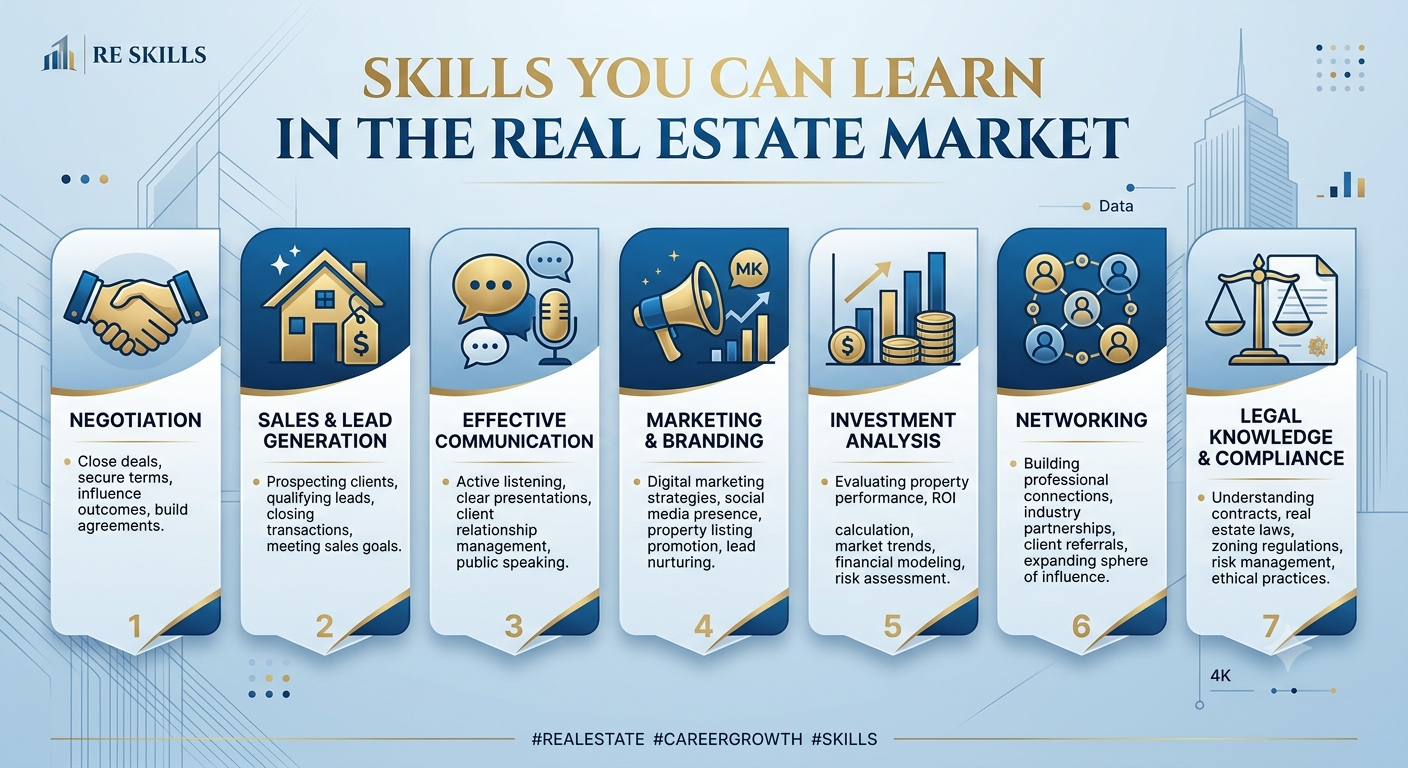
Success in real estate is rarely a matter of luck; it’s the result of a deliberate and continuous process of skill development. The modern real estate market demands far more than the ability to show a property and close a deal. Whether you are an aspiring real estate agent, a developer, or an investor, the sector’s increasing complexity and professionalization mean that a diverse and evolving skill set is your most valuable asset. As the industry advances, the margin for error reduces sharply, and a delay caused by inadequate supervision or a quality issue rooted in insufficient training can weaken even the strongest strategy.
The skills you can learn are broadly divided into technical “hard skills” and interpersonal “soft skills.” The most successful professionals are those who master the intersection of both.
1. Financial and Analytical Acumen: The Hard Skills
At its core, real estate is a numbers game. To make informed decisions for yourself or for clients, you must be comfortable with financial concepts and data analysis. The Harvard Extension School’s Real Estate Investment Graduate Certificate, for example, is designed entirely around building the financial analysis and market expertise to evaluate investments and navigate complex development decisions.
Financial Modeling and Analysis
This is arguably the most critical hard skill in the field. You need to be able to build and interpret financial models to analyze cash flow, determine property value, and measure investment returns across different asset classes and market conditions. Key financial metrics you must understand include:
Return on Investment (ROI): Measures the overall profitability of an investment. A good ROI in real estate investing typically falls between 8% and 12% annually.
Capitalization Rate (Cap Rate): Determines a property’s return relative to its purchase price.
Cash Flow: The money left after paying all property expenses. Positive cash flow means your property generates more income than it costs to maintain.
Understanding how to evaluate these metrics allows you to analyze property performance and compare investment opportunities effectively. This goes beyond simple arithmetic; it requires the ability to assess risk, conduct scenario analysis for uncertain market conditions, and evaluate complex debt and equity structures used in investment partnerships.
Market Analysis and Data Interpretation
Understanding the market is not just about following national headlines. It requires a granular, data-driven approach. You need to be able to:
Evaluate neighborhoods: Look at factors such as job growth, school quality, crime rates, and planned developments to assess a neighborhood’s growth potential.
Utilize data analytics tools: Online real estate platforms and sophisticated software offer insights into pricing trends and property values. The ability to interpret this data is crucial.
Analyze trends: You must understand how broader economic indicators (like interest rates) and urban development patterns shape real estate markets and identify opportunities.
This analytical expertise allows you to identify lucrative opportunities, whether you are analyzing land use and property values or assessing the potential of different property types like residential, commercial, or industrial assets.
2. The Human Element: Soft Skills Are Hard Assets
While numbers tell you what to buy, soft skills determine how you navigate the human side of the transaction. In a business where each transaction is a human story, soft skills are the connection between technical knowledge and substantive success. According to a 2025 survey of Singapore real estate employers, soft skills are taking centre stage, particularly when hiring fresh graduates. Analytical thinking and communication skills were rated as more important than market knowledge or financial modelling.
Communication and Persuasion
Relationships are the backbone of any real estate business. Each deal relies on trust, which begins with clear and effective communication. You must be able to:
Articulate complex information clearly: Explain mortgage jargon to a first-time buyer or sell a property’s potential to a developer in understandable terms.
Persuade and negotiate: Persuading is identified as a top-level skill for real estate agents, requiring the highest level of proficiency. Effective negotiation involves understanding your client’s interests and protecting them when interacting with third parties. It’s about seeking a middle ground that leaves all parties satisfied.
Emotional Intelligence and Empathy
Empathy has emerged as a game-changer. Property transactions are deeply personal experiences—families moving, couples downsizing, investors making life-altering decisions. Real estate professionals who can empathize with these experiences build stronger connections. This involves:
Social Perceptiveness: The ability to notice subtle cues and understand clients’ preferences, concerns, and emotional states.
Active Listening: Truly listening and comprehending a client’s needs and concerns allows you to adapt your approach and make clients feel understood and valued, creating loyalty and generating repeat business and referrals.
Adaptability and Resilience
The real estate market is inherently cyclical and subject to unexpected shifts. The COVID-19 pandemic, for instance, forced professionals to adapt to virtual tours, remote closings, and online marketing overnight. Those who were agile prospered; others who did not adapt fell behind.
Adaptability: Being open to change and modifying your approach to meet new demands is vital. The Skills for Success model identifies adaptability as a “Highly Important” attribute for real estate agents.
Resilience: This is the ability to bounce back from rejection and setbacks. In a sales-driven industry, you will face numerous “no’s” before a “yes.” Resilience helps you maintain a positive outlook and continue moving forward.
3. Operational and Legal Expertise
A successful career is also built on a solid foundation of operational knowledge and legal understanding.
Property Management
Whether you’re managing your own portfolio or advising clients, you need to understand the operational side of real estate. This includes:
Tenant Management: Conducting credit checks, income verification, and managing lease agreements.
Maintenance and Repairs: Knowing how to handle routine maintenance and build a network of reliable contractors to prevent small issues from becoming costly repairs.
Risk Management: Understanding how to mitigate financial and legal risks, such as keeping an emergency fund for market downturns, understanding local tenant laws, and ensuring you have the proper insurance (like landlord and umbrella insurance).
Legal and Regulatory Knowledge
Real estate is heavily regulated, and a lack of knowledge can be a significant liability. You must develop a strong understanding of:
Local Laws and Regulations: From zoning policies to tenant rights, being well-versed in intricate local regulations is crucial.
Contracts and Compliance: You need to thoroughly read and comprehend legal documents, contracts, and agreements to ensure all terms are understood and accurately represented. This also includes understanding emerging regulatory changes, such as those from the National Association of Realtors’ commission settlement, which place a greater emphasis on transparency and client counselling.
4. The Digital Frontier: Technology Skills
The industry is increasingly digitized. Technology has revolutionized everything from property searches (via digital platforms and virtual tours) to the use of data analytics for decision-making.
PropTech Literacy: Familiarity with digital tools is no longer optional. This includes using property management software to automate rent collection and track maintenance, using AI-driven analytics to evaluate deals, and utilizing CRM (Customer Relationship Management) systems to manage client relationships.
Marketing and Social Media: Agents must be adept at advertising their services and properties online. This means being able to create and manage social media campaigns and use digital platforms to generate leads.
Conclusion: The Path of Continuous Learning
The most critical skill you can learn in real estate is a commitment to continuous learning. The industry is dynamic; investment strategies that worked yesterday might not work tomorrow. The professionals who thrive are those who take ownership of their professional development, actively assessing their competencies against the evolving demands of the market.
According to research from Stanford and Carnegie Mellon, 75% of long-term career success is based on soft skills, underscoring the importance of mastering the human element of the business. Whether you choose to pursue formal education, such as a graduate certificate from a university, or learn through mentorship and real-world hustle, your willingness to develop both the technical and interpersonal dimensions of your skill set will ultimately define your trajectory in the real estate market.



Join The Discussion